



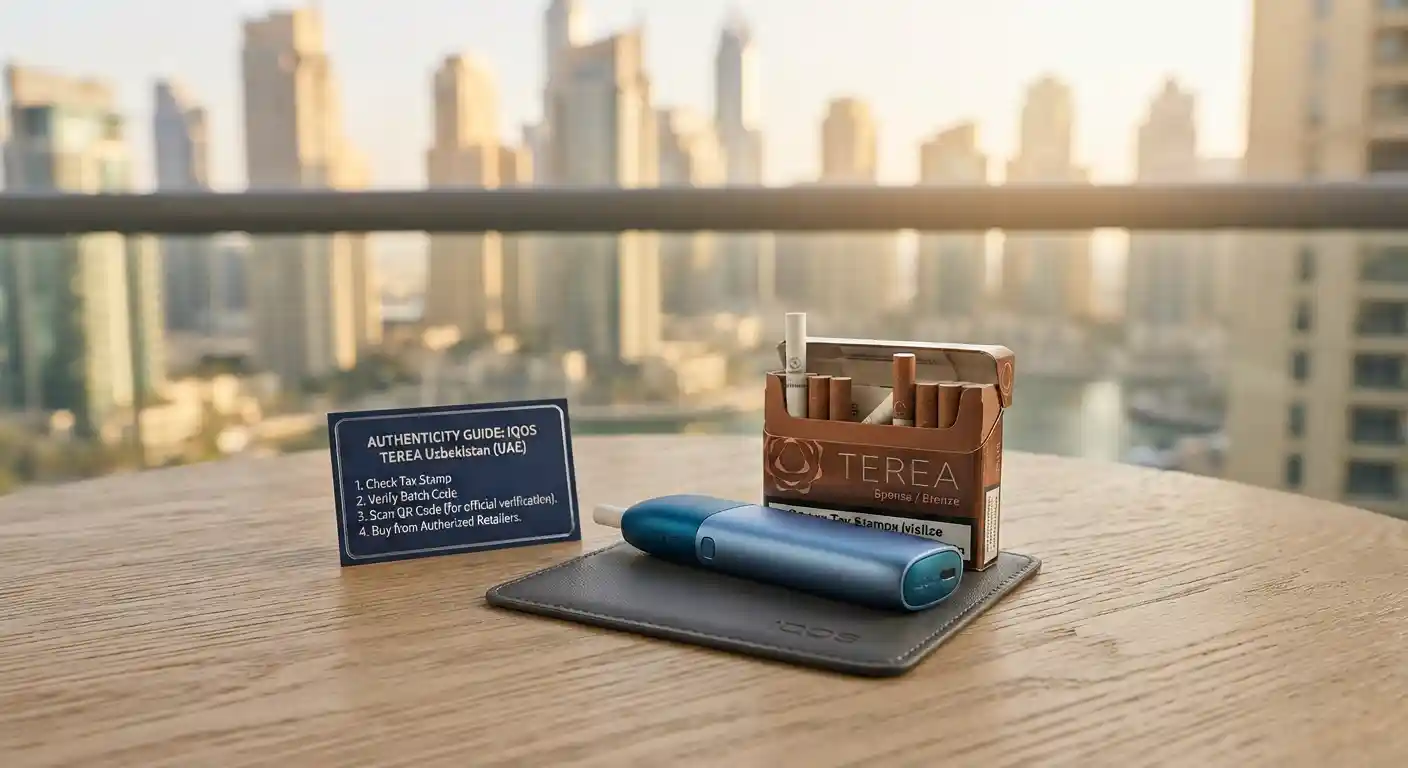

IQOS TEREA Uzbekistan buyers in the UAE should verify three things before paying: the pack itself, the seller’s paper trail and the stock’s local tax status. A listing for iqos uzbekistan may describe genuine imported goods, but the country name alone says nothing about who imported them, how they were stored or whether they comply with UAE retail requirements.
The sensible approach is to inspect first and leave sealed stock untouched if the evidence conflicts. Packaging checks reduce risk, but they cannot certify contents or make heated tobacco risk-free. These products are for adult nicotine users, not minors or non-smokers.
Why IQOS TEREA Uzbekistan Attracts Fakes in the UAE Market
Uzbekistan-market TEREA interests UAE buyers because it sits outside the assortment commonly encountered at mainstream retailers in Dubai, Abu Dhabi and Sharjah. That novelty creates an information gap. Most buyers have not handled enough verified packs to recognise the correct warning panel, code position or print finish from memory.
The imported range also includes distinctive regional variants. The tidal pearl terea flavor, for example, is a Kazakhstan-market TEREA option whose Pearl branding, colour treatment and regional text differ from standard Uzbekistan packs. It matters in an authenticity check because sellers sometimes use images from one regional variant to advertise another, while counterfeiters mix familiar TEREA elements into a pack design that never existed in that combination.
Do not assume every unfamiliar pack is fake. Genuine gray-market goods are authentic products brought through an unofficial or parallel supply route. Counterfeits imitate the product itself. The awkward truth is that a pack can be genuine at origin yet still have weak traceability, uncertain storage and inadequate evidence of compliance for retail sale in the UAE.
A practical first screen is simple: compare the delivered country, variant and device family with the written order. If a seller advertises Uzbekistan stock, sends Kazakhstan packs and calls the difference “new packaging,” stop there. A country substitution is not a cosmetic update.

The Packaging Details Genuine Stock Has
Begin with the unopened carton rather than a single loose pack. Look at how the cellophane closes, whether the tear strip runs evenly and whether the carton flaps sit flat. Genuine manufacturing is controlled, so repeated glue smears, ragged folds, doubled lettering or noticeably wandering print are more meaningful than one tiny cosmetic flaw.
Next, place two or three packs from the same carton beside one another. Warning panels, manufacturer details, colour blocks and product names should follow the same layout. Codes should use a consistent format and application method, without obvious scraping, stickers placed over earlier codes or ink that wipes away under light handling.
- Check the exact country and variant named on the invoice against every delivered pack.
- Read small text for spelling changes, broken characters and abrupt font shifts.
- Confirm that seals are intact and show no heat damage or cloudy adhesive.
- Make sure the stated product family matches the device the sticks are designed for.
Then assess the UAE tax position separately. Tobacco products offered through normal UAE retail channels should carry the applicable local tax marking. A foreign-market warning panel or overseas excise mark does not perform the same function, even if the underlying product is genuine.
Here is the trade-off buyers often miss. An Uzbekistan pack with coherent manufacturing details may be genuine imported stock, but without credible local compliance evidence it remains a poor retail purchase in the UAE. Conversely, a tax mark is not a magic authenticity seal. Marks can be damaged, misapplied or imitated, so it must agree with the pack, invoice and seller’s explanation.
Ask before delivery whether the goods have the required UAE marking and request a clear photograph of the actual batch, not a catalogue image. On arrival, compare that photograph with the sealed carton. If the seller avoids the question or says foreign packs never need local compliance because they are “personal imports,” do not accept that claim as proof for a commercial sale.
The Retailer Signs That Actually Mean Something
A polished website and a WhatsApp number are easy to arrange. Useful evidence is less glamorous: an identifiable UAE business, a working contact route, a dated invoice and terms covering unopened or incorrectly supplied goods. The invoice should state enough detail to connect the payment with the delivered market, variant and quantity.
Good retailers answer specific questions without improvising. Ask which market the packs were produced for, whether the photographs show the current batch and what happens if codes or seals differ on arrival. “All imported packs are different” is not an adequate response. Regional variation exists, but packs within one disclosed batch should not look randomly assembled.
I would also test the seller with a compatibility question before ordering. A competent answer should distinguish TEREA sticks intended for compatible IQOS ILUMA devices from older blade-based formats. If the response is simply “all IQOS sticks work,” the seller either lacks basic product knowledge or is prepared to say anything to close the sale.
Reviews are useful only when they describe verifiable parts of a transaction. Comments about sealed cartons, accurate invoices, batch photographs and a resolved return carry more weight than twenty near-identical five-star remarks posted together. Search snippets and social follower counts provide even less protection because neither identifies the stock you will receive.
Payment behaviour reveals plenty. A seller who switches the account name at the last minute, refuses an invoice and demands an immediate bank transfer has removed several ways to challenge the transaction. Traceable payment does not prove authenticity, but it gives you a record and discourages sellers who depend on disappearing after delivery.
Where IQOS TEREA Tidal Pearl Kazakhstan Sits on the Same Trust Question
Tidal Pearl Kazakhstan should be assessed as its own regional product, not as a colour variation of an Uzbekistan pack. Use a reference that matches the same country, product name and device family. Comparing it with unrelated UAE or European packaging can produce false alarms because legitimate warning layouts and market text may differ.
Product-family confusion deserves particular attention here. The heets teak flavor belongs to the HEETS line for compatible blade-based IQOS devices, while Tidal Pearl is presented as TEREA for the ILUMA system. A listing that borrows a HEETS description for a TEREA pack is not merely untidy. It suggests the seller has not verified the item or is recycling content across incompatible products.
For a Kazakhstan-market pack, record the full front, back, base, top and both side panels before opening it. Compare the product name, regional text, warning placement and printed codes with the seller’s own pre-sale batch photographs. This is stronger than matching one online front image, which counterfeiters can copy easily.
Suppose a six-pack delivery contains five packs with crisp side-panel text and one with a different warning arrangement, a shifted logo and a code in another position. A genuine production change could explain one feature. Three unexplained changes inside what was sold as a single batch justify leaving the odd pack sealed and requesting the source or batch explanation in writing.
Local tax compliance still needs its own check. A coherent Kazakhstan pack may indicate genuine foreign-market manufacture, while the absence of appropriate UAE retail marking points to an unofficial or potentially non-compliant supply route. That distinction matters: gray-market does not automatically mean counterfeit, but it gives the buyer less recourse and a weaker chain of custody.
Do not let rarity settle the argument. Limited availability can explain a higher price or irregular supply, but it cannot explain resealing, mismatched product families, altered codes or a retailer who will not identify what is being sold.
The Small Habits That Protect You
Save evidence before the courier arrives. Keep screenshots of the listing, the promised country of origin, the seller’s batch photographs, the invoice and the payment confirmation. Listings can be edited quickly, and a screenshot often settles whether the delivered variant was substituted.
- Photograph the unopened parcel and shipping label before cutting the outer wrapping.
- Record all carton faces, seals, tax markings and visible codes in good light.
- Compare the market, variant and quantity with the invoice line by line.
- Inspect every pack before opening one, especially in mixed or discounted orders.
- Keep the carton and at least one untouched pack until any dispute is finished.
QR codes need restraint. A working code may have been copied from genuine packaging, while a failed scan can result from damage or a market-specific system. Never install an unknown application or enter banking details merely because a sticker tells you that verification requires it.
A quick message to the seller can be revealing. Send a photograph of the discrepancy and ask one narrow question, such as why two code formats appear in the same sealed carton. A retailer who checks the batch and offers an exchange is behaving differently from one who blames your camera, tells you to open the pack or deletes the conversation.
Finally, resist sensory “testing.” Smell, taste and aerosol cannot establish authenticity, and poor storage can change a genuine product. Opening suspicious stock also weakens a return claim. Keep it sealed, document the problem and deal with the evidence rather than experimenting with the contents.
When to Walk Away From an Offer
Reject any offer where several weak signals appear together. A concrete example is a seller advertising cartons at a steep, unexplained discount, accepting payment only by transfer to a personal account, promising “mixed Uzbekistan stock,” and refusing to photograph the current tax marks because the carton is supposedly already with the driver. No single detail proves counterfeiting, but that pattern leaves almost no accountable chain of sale.
Opened, wet, crushed or resealed packs should also be refused unless the condition was disclosed and you knowingly agreed to it. The same applies when a Tidal Pearl order arrives under a different country designation, or when loose packs carry several warning layouts despite being described as one factory batch.
- Walk away if the seller will not issue an invoice.
- Reject pressure to open or use questionable sticks before a return is approved.
- Do not accept stickers covering codes, warnings or earlier tax markings.
- Stop if the seller changes the product family after payment.
Packaging inspection has a firm limitation: it can expose inconsistencies, but it cannot tell you with certainty what material is inside a convincingly copied pack. Nor can photographs prove storage temperature, lawful import history or an unbroken chain of custody. That is why seller records and local compliance matter as much as print quality.
If doubts remain, leave the goods unused and contact the retailer in writing. Keep the photographs, invoice and payment record, then raise the issue with the marketplace, payment provider or relevant UAE authority where appropriate. For an adult buyer, walking away from uncertain stock is cheaper than trying to prove an unsupported sales story after the packs have been opened.
Related Reading: IQOS TEREA vs JUUL: Cost, Convenience and Flavor

