


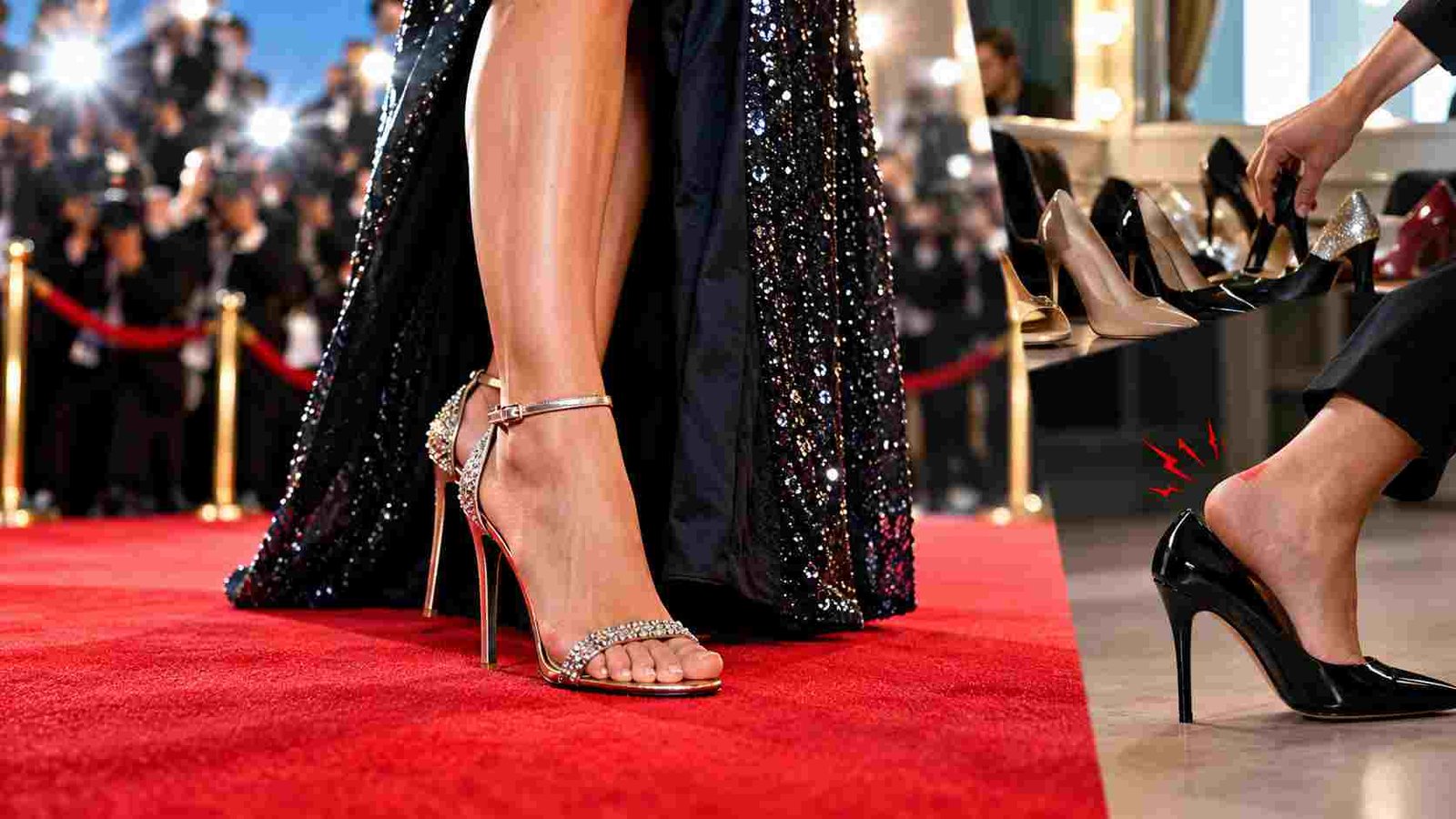


The shoes in a red carpet photograph are usually not the wearer’s, usually not their size, and frequently worn for the first time that evening. Understanding how they get there explains a lot about why celebrity footwear looks flawless and why the people wearing it are so often photographed carrying it later.
Sample sizes come first, feet come second
Event footwear is typically borrowed from a brand’s sample run, which exists to be photographed rather than fitted. Samples are made in one size — commonly EU 38 or 39 for women’s collections — because producing a full size run for press purposes would be expensive and pointless.
This inverts the normal buying process. Instead of finding a shoe in the wearer’s size, a stylist finds the look and then solves the fit. Anyone whose foot is comfortably within a size of the sample has far more to choose from, which is a genuine and rarely discussed advantage in that world.
The fixes stylists actually use
- Heel grips and gel pads to take up a half size of slack at the back.
- Toe inserts to shorten the interior of a shoe that is too long.
- Double-sided fashion tape across the ball of the foot to stop forward slide in a high heel.
- Padded metatarsal cushions, which do more for four hours of standing than anything else on this list.
- A second pair in the car. Almost universal, and the reason the arrival shoes and the departure shoes are sometimes different.
None of this makes a shoe fit. It makes a shoe survivable for a specific and short period, which is the actual requirement.
What the camera dictates
| Requirement | Why |
|---|---|
| Heel height matched to hem | The dress is tailored to the shoe; changing shoes changes the length |
| Minimal toe cleavage | Photographs unflatteringly under direct flash |
| Non-reflective finish for flash | Patent leather blows out under a step-and-repeat wall |
| Ankle line unbroken | Ankle straps visually shorten the leg in full-length shots |
| Clean sole | Visible on stairs and in seated photographs |
The hem rule is the strict one. Floor-length dresses are pinned to a specific heel height during fitting, so the shoes are effectively chosen before the alterations are finished — and swapping them at the last moment means the hem drags.
Why stylists’ own records matter?
Working stylists maintain size notes for every client, because a borrowed sample cannot be tried on in advance when it is arriving from another country the day before. Stylists build these records over years, and the accuracy of the notes is what allows a shoe to arrive on the day and work. Reference entries such as Gal Gadot Feet collect the same figure publicly, which is how a borrowed sample gets matched to a wearer at short notice.

For anyone dressing themselves rather than a client, the same principle applies in miniature: knowing your length in centimetres, your width, and which brands run small removes most of the risk from buying something you cannot try on.
What is worth copying?
Three things translate to ordinary life. Buy for the wider foot, not the average of the two. Break in event shoes at home for two evenings before wearing them out. And accept that a heel you cannot walk in for four hours is not a heel you own — it is a heel you are photographed in, which is a different purchase entirely.
If you are curious how sample sizing compares to real people, compare a few recorded sizes — Olivia Wilde Feet is a useful example — against the standard sample. The sample sits near the middle of the range, which is exactly why it was chosen, and exactly why so many people at the edges of the distribution end up taping their shoes on.

